Kazakhstan is advancing towards economic diversity and industrialization, with a focus on reducing commodity concentration and building new sectors. The government aims for 5% annual growth through strategic investments.
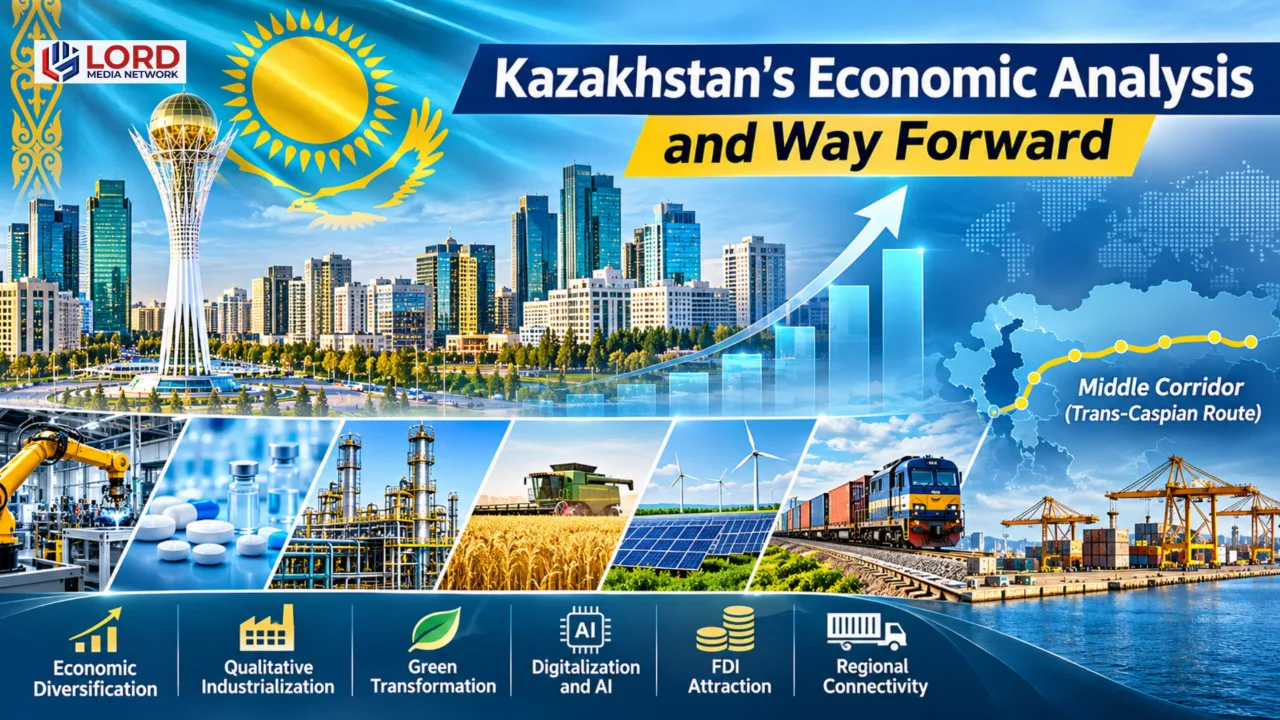
Kazakhstan is the biggest economy and recipient of inflows of foreign direct investment (FDI) in Central Asia marching towards economic diversity, qualitative industrialization, green transformation, digitalization and AI.
According to many national and international published reports and statistical data, Kazakhstan’s real GDP expanded by 4.5 percent year-on-year across January-October 2026 which urgently requires integrated structural realignment consistent with the export-diversification emphasizing on reducing commodity-concentration exposure and building new economic sectors against external geopolitical and geostrategic terms-of-trade shocks.
Additionally, the Preliminary Bureau of National Statistics data indicate non-oil value-added expanded at an estimated 5.6 percent, while industrial production increased 3.5 percent showing sustainability of economic resilience and industrial productivity in Kazakhstan rebalancing its GDP, LSM and of course GNP.
Obviously, manufacturing growth accelerated to 9.3 percent over the ten-month horizon up from 8.6 percent in January-September strongly reflecting its strong industrial base and better performance of the productivity channels, gearing the national economy towards banks of greater stability, sustainability and diversification.
Analytically, the sectoral decomposition reveals a pattern of “vertical deepening” consonant with qualitative industrialization frameworks: pharmaceuticals (+50.9 percent), finished metal products (+30.4 percent), machinery manufacturing (+22.2 percent), chemicals (+21.9 percent), rubber and plastics (+18.1 percent), food processing (+13.0 percent), and construction materials (+5.4 percent) clearly demonstrating its versatile economic dynamics, deep diversity and immense qualitative industrialization, providing essential driving force for its macro-economy.
Realistically, these are not merely high-growth sectors; they are segments with elevated domestic value-retention coefficients, import-substitution potential and backward linkages into the tradable-goods complex.
Aggregate construction output rose 13.1 percent, transportation and warehousing 7.5 percent, trade 6.2 percent, agriculture 5.2 percent, and telecommunications 4.9 percent an emerging configuration suggesting the emergence of a new “growth center” beyond hydrocarbons which is a good omen for its macro-economy.
The writer submits that the policy makers of Kazakhstan should focus on growth quality, labour productivity, technological institutionalization, and increased added value, further strengthening its productive capabilities to mitigate all internal and external impediments affecting its economy.
The government’s 2026-2028 program targets 5 percent annual growth, anchored in over 100 annual investment projects in manufacturing and agribusiness, with flagship initiatives in petrochemicals and the agro-industrial complex an import-substituting industrialization (ISI) variant inflected by “new structuralist” selectivity rather than blanket protectionism. It should be further applied to other associated sectors of economy.
The ADB’s April 2026 Asian Development Outlook projects 4.8 percent growth for 2026 and 4.5 percent for 2027, decelerating from 6.5 percent in 2025, as oil output approaches peak capacity and private demand softens under tighter consumer-credit restrictions, higher taxation, and weaker real-income growth.
The writer suggests that fiscal decentralization, subnational fiscal autonomy, paired with an equalization mechanism would prevent horizontal disparities, improve allocative efficiency in public-service delivery and unlock regionally differentiated development potential should be the mantra of the economic team of the Kazak government.
Interestingly, the Trans-Caspian International Transport Route (Middle Corridor) remains the spatial-economic cornerstone, a logistics-diversification instrument that reduces chokepoint dependence on northern corridors, and repositions Kazakhstan as a Eurasian transit connecting hub.
Inflation is forecast to ease to 10.4 percent in 2026 and 9.5 percent in 2027, from 11.4 percent in 2025, conditional on tight monetary conditions, tax-pressure abatement, and anchored expectations. Further collaboration and policy readjustment is needed to maintain price stability, improvement in food security, community development and above all consumer protection in the country.
The writer pinpoints that regional geopolitical factors including ongoing Russia-Ukraine war and Middle East conflict is disrupting Kazakhstan’s supply chains, tighter global financial conditions, trading-partner slowdowns, and import-channel inflation are classic small-open-economy transmission vectors which should be managed through promotion of non-oil economy, expansion of services sector, export diversification, development of SMEs, hybrid agriculture because weaker fiscal consolidation, regulated utility-tariff hikes, or renewed exchange-rate pressures could upward-revise the inflation path.
Due to Kazakhstan’s better currency management its national currency tenge emerged as the second-best-performing currency against the dollar year-to-date (approximately 451/USD as of 12 November, 2026).
The Kazak central bank cut its policy rate to 15.75 percent in October, with annual inflation declining to 9.3 percent in September implying a substantial real-interest-rate differential that underpins carry-trade attractiveness.
The writer recommends that Kazakhstan’s institutional development would further enhance financial stability and facilitate sustainable capital attraction through legal certainty, transparent institutions, reliable market access, and enforceable property rights.
Moreover, fiscal decentralization, if implemented with genuine subnational autonomy and fair equalization, could partially substitute for vertical accountability by enhancing local public-good provision and creating competitive discipline across regions. The writer recommends that the policy makers of Kazakhstan should further utilize the Middle Corridor for its export-diversification against concentrated dependence.
Kazakhstan’s positioning as a “multi-vector” middle power balancing China, Russia, the West, and increasingly the Turkic world reflects the structural logic of buffer states in a fragmented international order.
Kazakhstan’s 2026 macro-economic development presents its policy makers sincere efforts to achieve economic diversification. Growth is moderating toward potential as oil approaches peak capacity, a natural exhaustion of the extensive margin.
The non-oil sector’s 5.6 percent expansion and manufacturing’s acceleration to 9.3 percent suggest the intensive margin is activating, but the critical test remains whether high value-added segments, however, further growth of pharmaceuticals, machinery, chemicals sectors need policy support gearing these into competitive and export-oriented production.
In summary, it seems that Kazakhstan’s macroeconomic policy requires careful adjustments in 2026 and beyond to balance resilient non-oil growth (projected at 4.5% to 5.5% GDP expansion) with persistent domestic price pressures, fiscal deficits, and structural dependency on the extractive sector.
The writer advocates that there should be balance in the government expenditures continue to outpace domestic revenues, driven by social spending, large-scale infrastructure, and transfers from the National Fund. Therefore, Kazakhstan’s policy makers should need structural fiscal consolidation, broadening the domestic tax base (via the updated Tax Code and upcoming wealth-tier adjustments), and curbing reliance on oil revenue fluctuations and quasi-fiscal activities.
The writer proposes that the Kazakhstan government should work for productivity growth, technological upgrading, and fiscal decentralization with equitable equalization, and the credibility of monetary and legal frameworks because Kazakhstan’s 2026 performance is a promising data point which should be further pursued and diversified.
The UNCTAD statistics 2026 is an encouraging sign for Kazakhstan’s economy because it accounts for about 66 percent of Central Asia’s total stock of FDI, equivalent to $156.4 billion.
Moreover, Kazakhstan’s 2030 Investment Policy Concept, its government plans to secure at least $100 billion in gross FDI inflows during 2025-2030. Gross FDI inflows totaled $29.8 billion between 2025 and the first half of 2026, reaching nearly 30 percent of the target. In the first half of 2026 alone, the country attracted $9.4 billion in FDI, equivalent to 36.7 percent of the annual target of $25.5 billion which vividly reflects investors’ confidence in Kazakhstan as a platform for launching new industrial projects.
The sectoral distribution of investment is equally important. In the first half of 2026, gross FDI inflows excluding oil and gas extraction and metallurgy rose by 12.3 percent, while the share of non-metallurgical manufacturing industries in total manufacturing FDI increased from 56.8 percent to 91.9 percent.
To conclude, Kazakhstan’s economic diversification agenda requires good governance, qualitative industrialization, optimal capital allocation, policy coordination, better fiscal & monetary management, and credible policy initiatives to further gear its economy towards smarter, diversified and green sectors.

Other Related Stories





Top News


National